





8 cylinder front engine iconic vehicle
  • User avatar
  • User avatar
  • User avatar
  • User avatar
  • User avatar
  • User avatar
  • User avatar
By hernanca
#313176
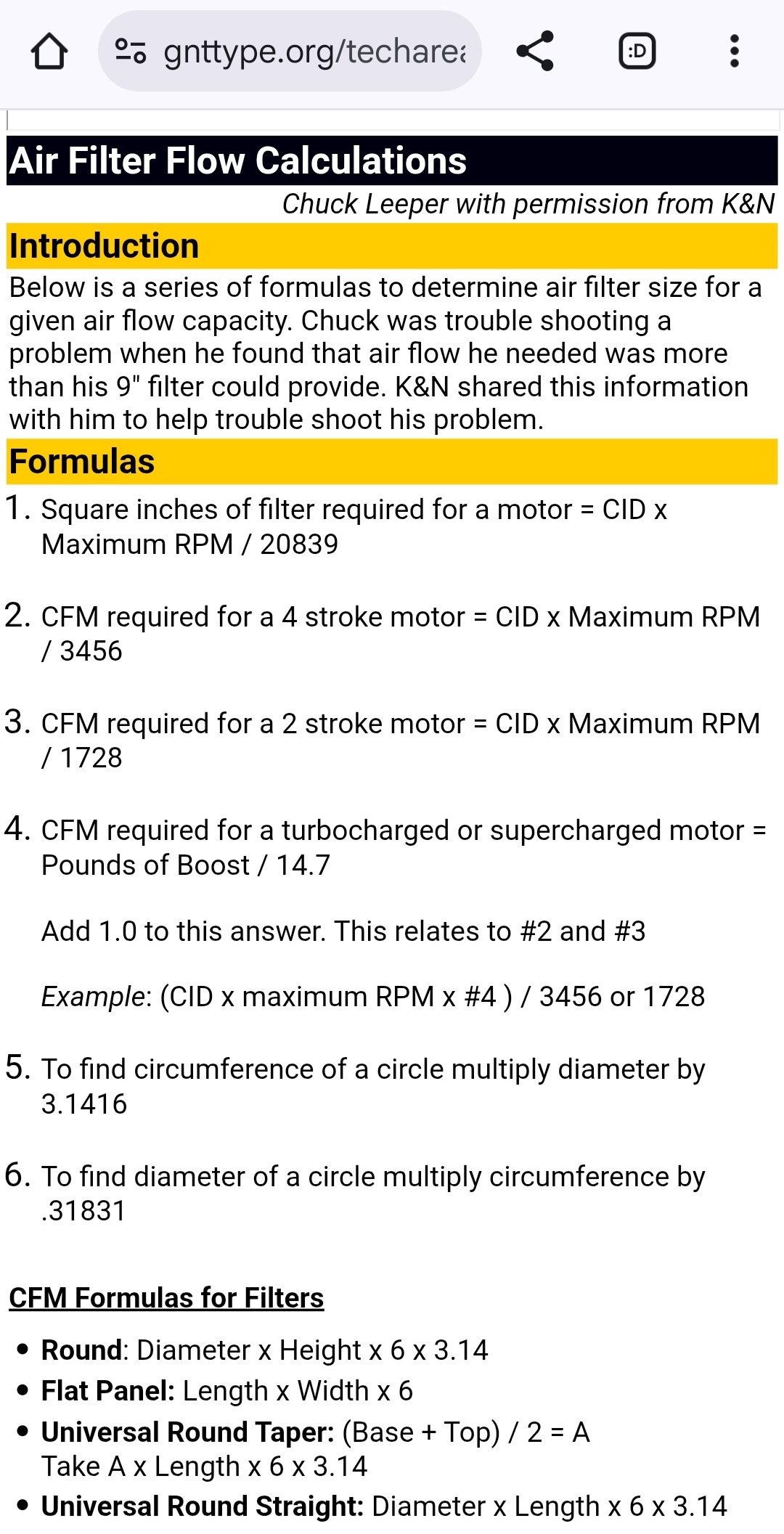
So, I was looking through the K&N site and stumbled across their formula for target "effective filter area":

((Displacement in cubic inches) x
(Max RPM)) / 20839 = effective filtering area

It seems to be based on the desirable CFM for the same Displacement and max RPM (see first attachment).

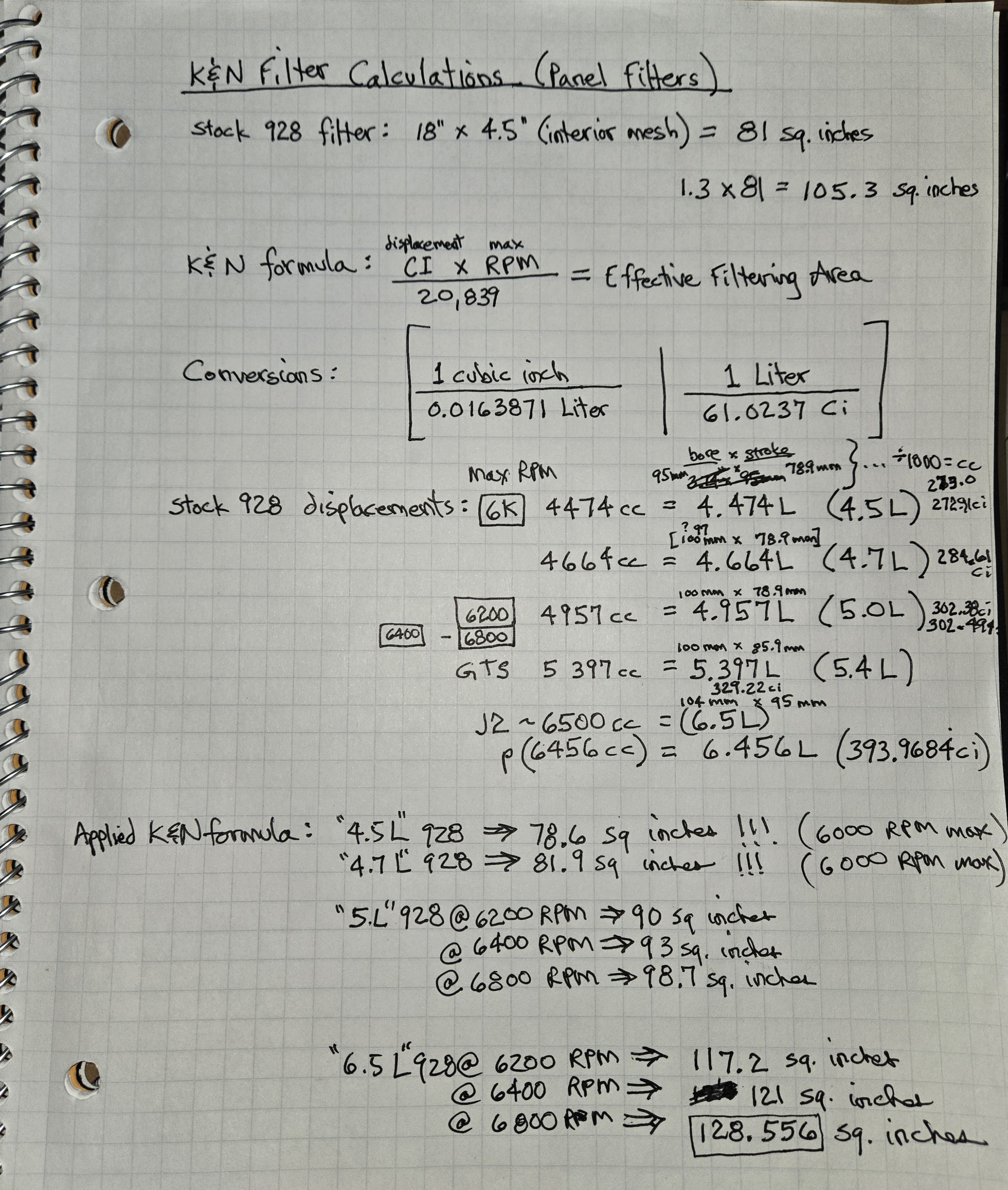
I measured my 86.5 stock air filter's actual mesh filter portion and came up with 81 square inches (18 * 4.5 inches). I am assuming all 928 filters are the same size? Then I applied the K&N formula to different model year 928's that I could easily find info on. Interesting results (second attachment).

Note that I found different Redline numbers (6200, 6400, 6800) for the stock 5L motors, so I applied the formula using each redline value I found, and also applied that to my "6.5" motor. Also, it is not obvious, but I used the actual Displacement values (e.g., 4474cc for the 4.5L) and converted them to cubic inches Displacement before applying the K&N formula.

Don't know how much difference it might make, but I am a firm believer in "every little bit helps", and also Math. I believe I need additional "effective filter area" for my "6.5" stroker, and am considering cowl induction anyway.

Bottom line, according to the K&N formula, our filters were sized for the original 4.5L and 4.7 engines, but are undersized after that, for the desirable CFM. See attachments.
Image

Image
worf liked this
By worf
#313197
Carlos, interesting stuff there.

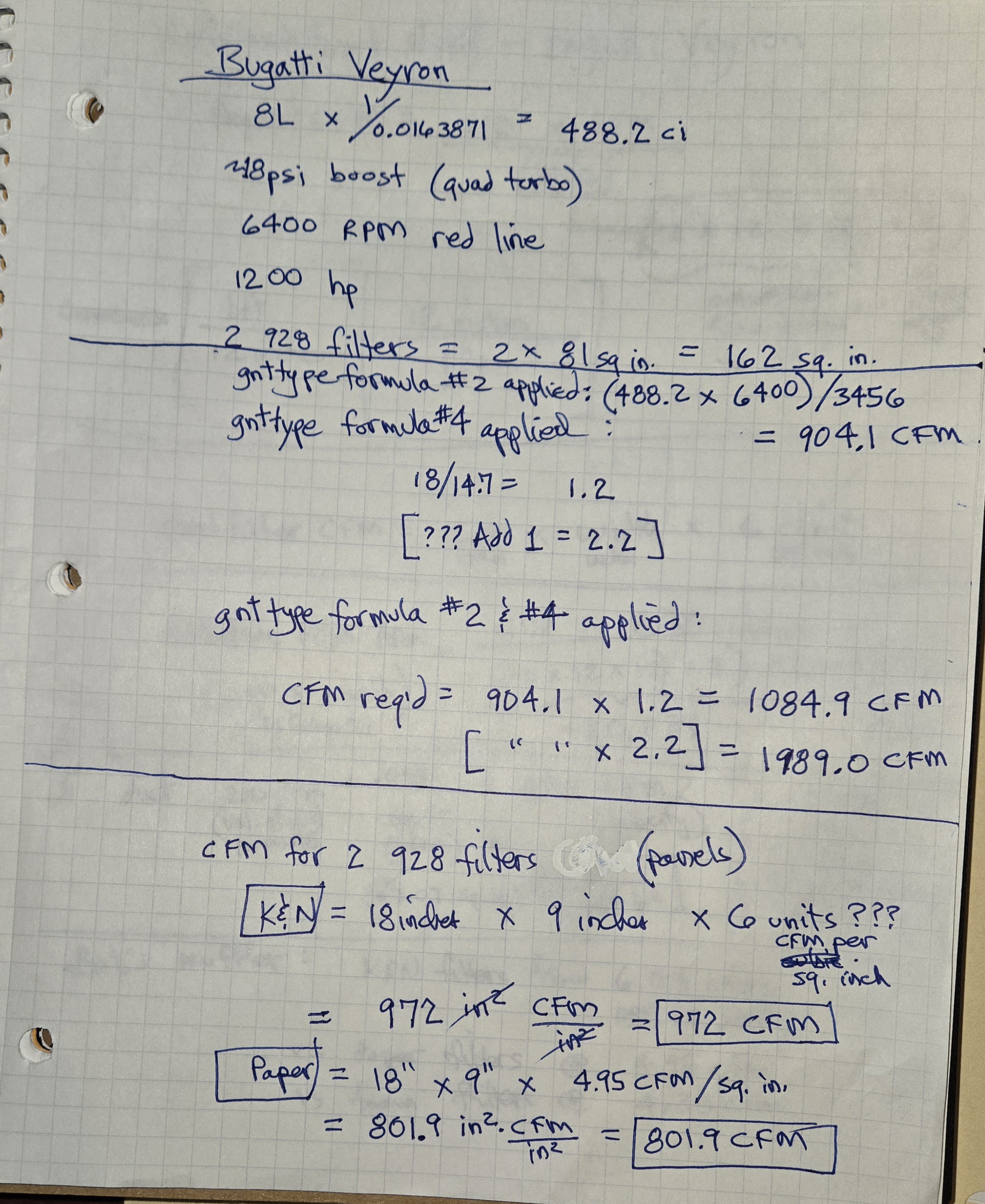
The 8 liter, ~18 PSI quad-turbo, 1200 hp, 6400 RPM Bugatti Veyron uses two 928 air filters.

What does the K&N formula say for that motor?
h2pmr, Hey_Allen liked this
By maddog2020
#313253
6.5 liters at 7800 RPM's should be interesting. cylinder head air flow should come into the picture somehow as well.
By hernanca
#313258
Short Answer:
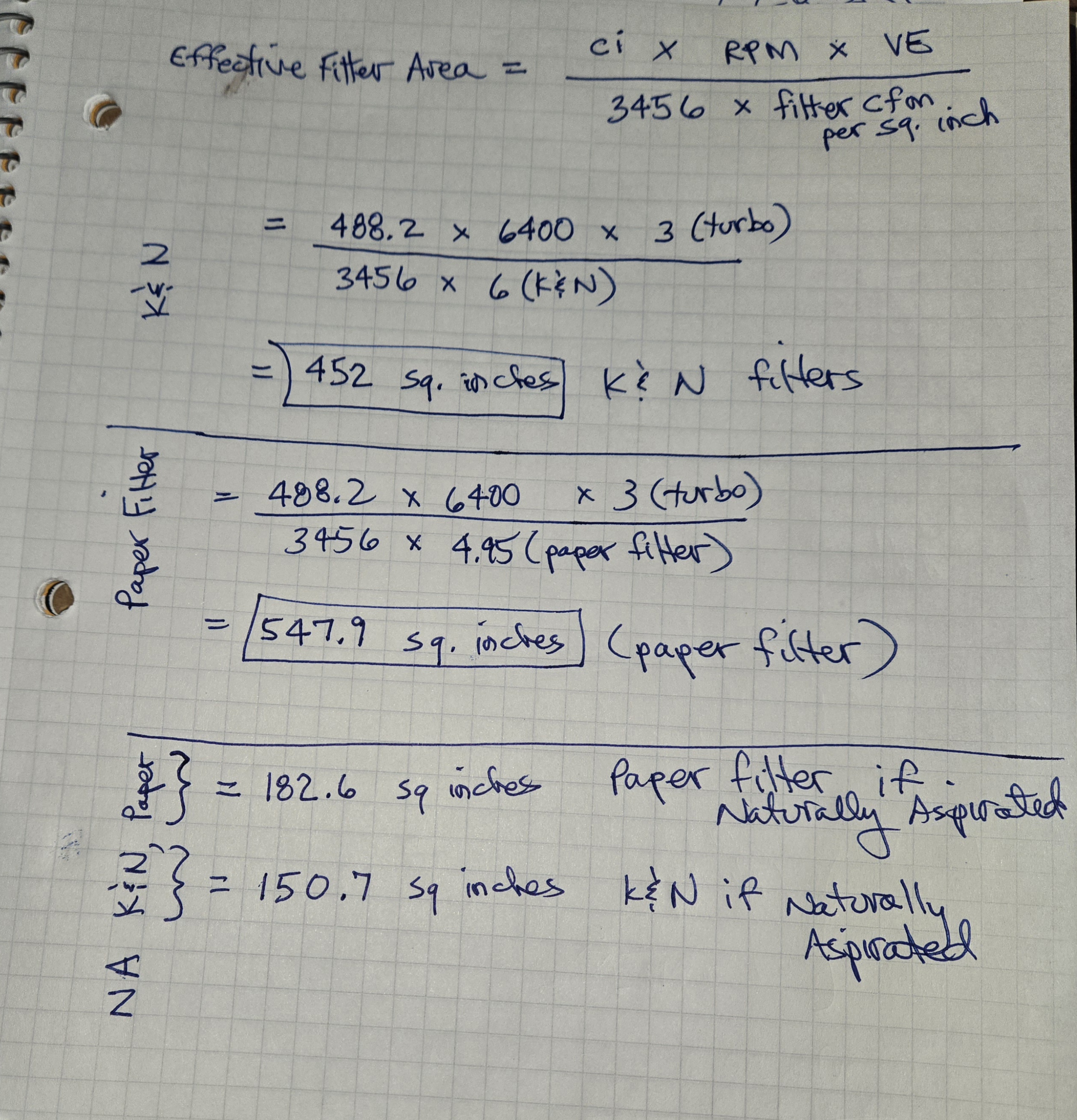
2 928 filters are not enough for that Veyron based on the K&N formulas.

Long Answer & Calcs:
So, I had to disect and verify the formula, in order to try to apply it to the Veyron. The K&N formula does not talk about boost, but similar formulas pop up elsewhere and they seemed to point out that the basic formula (like the K&N one) assumes 100% VE. (I have been told this is true for the 928.)

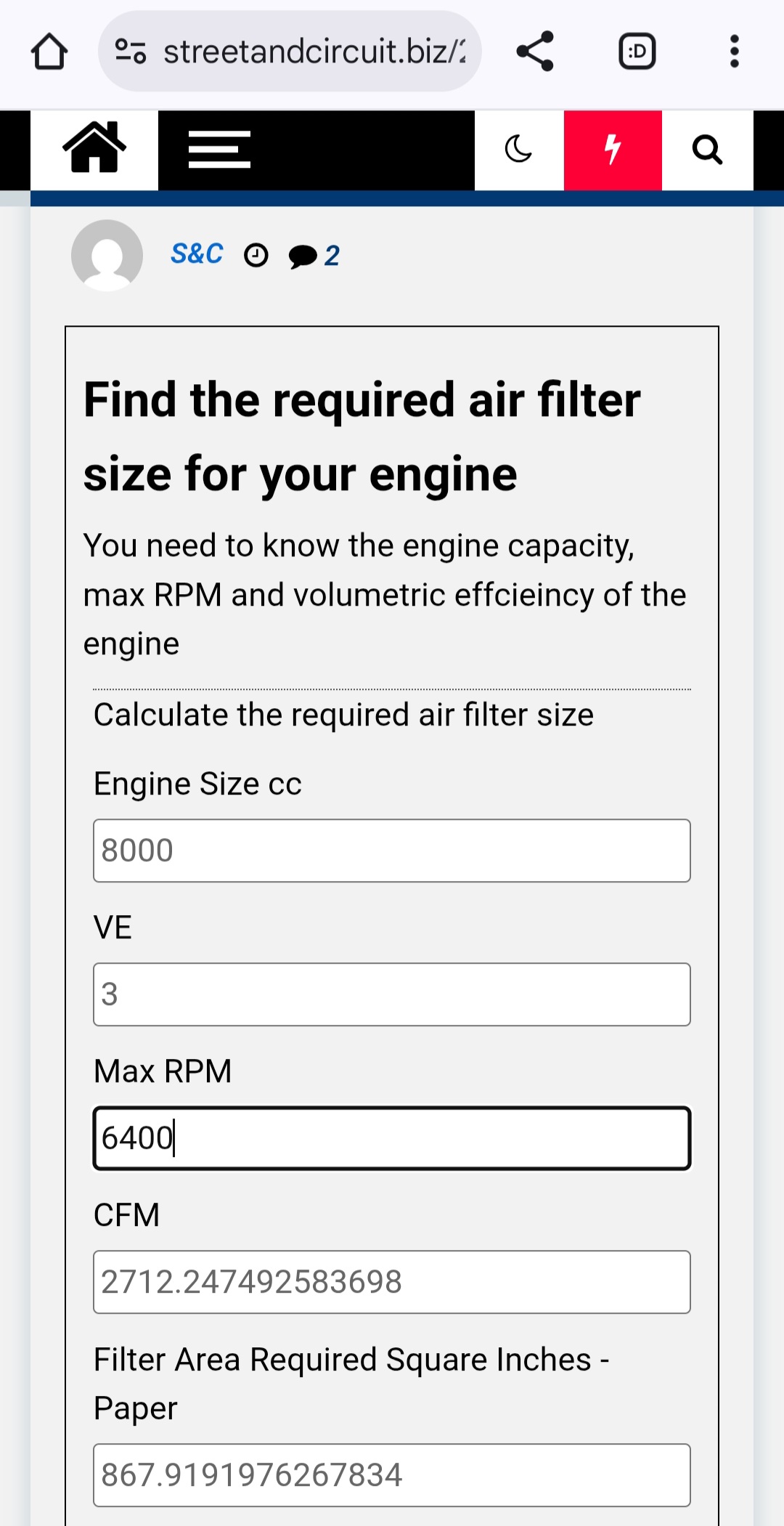
For boosted cars, the formula is modified by multiplying the numerator (top guy) by a factor representing greater than 1.0 (>100%) VE. One site recommended using 3.0 for very efficient turbo cars, so I used that.

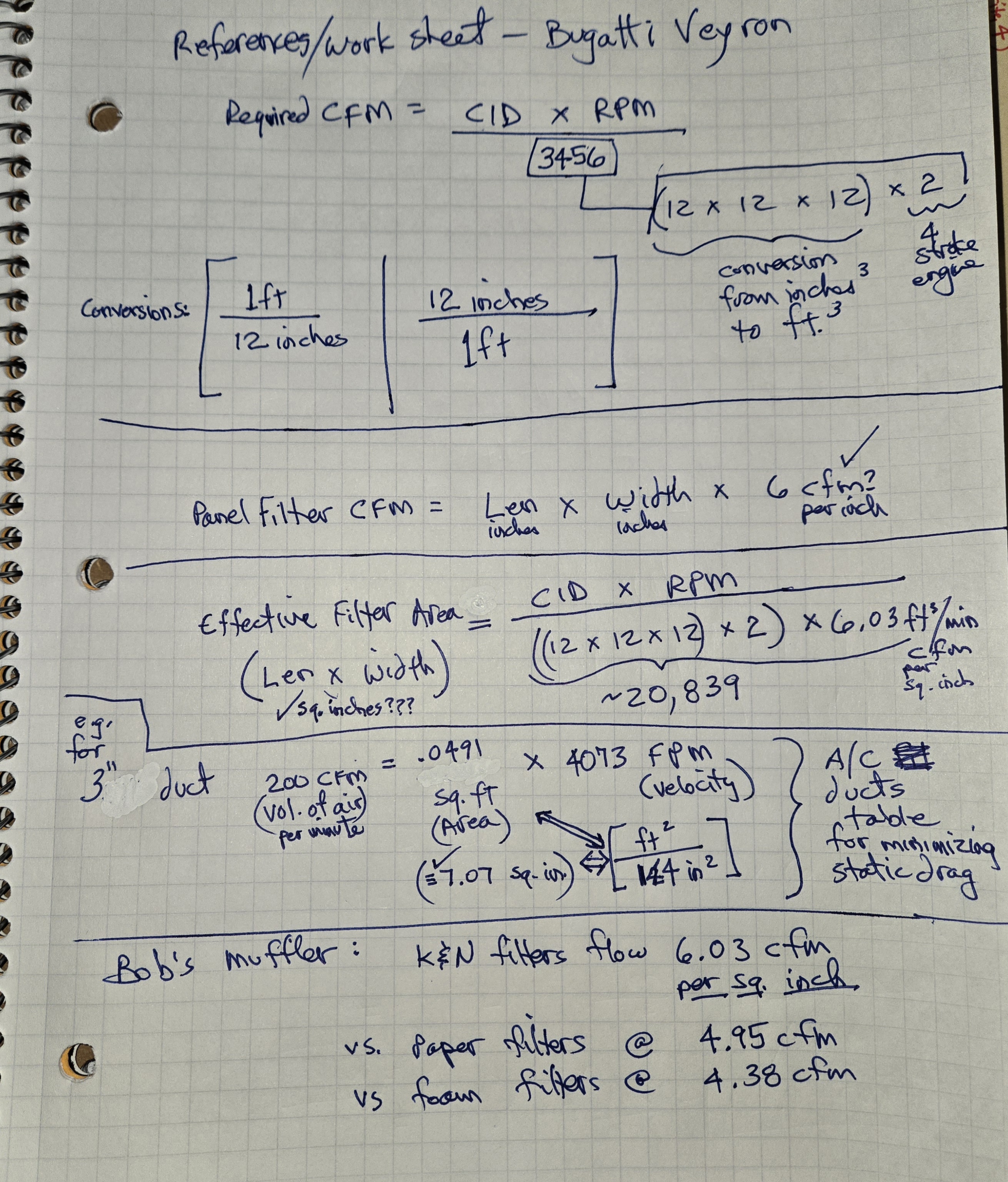
The other thing I figured out is that the bottom value (denominator of 20839) represents 12x12x12x2x6.03. The 3 12's are a conversion factor from ci to cubic feet for the CFM value. The 2 is to divide by 2 because its a 4-stroke (2 revolutions per complete cycle) and the 6.03 is K&N's claim that their pleated panel filters flow 6.03 CFM Per Square Inch (I may have rounded down to 6.00 in my calcs, fyi). The latter units make everything work out to a final value of square inches. Some site claimed paper filters flowed 4.95 CFM per square inches, so I also punched in that value separately.

I need to create an Excel for this....

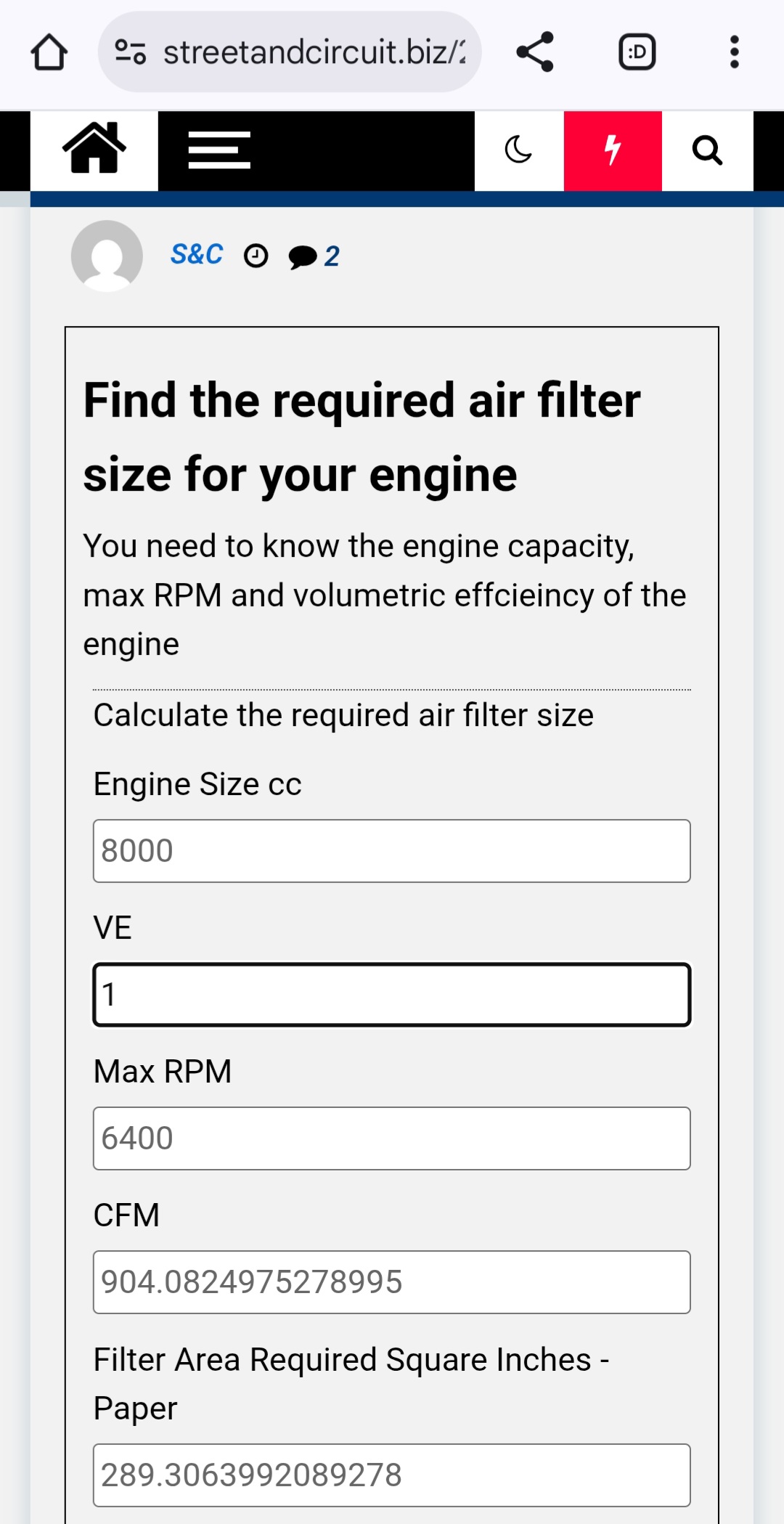
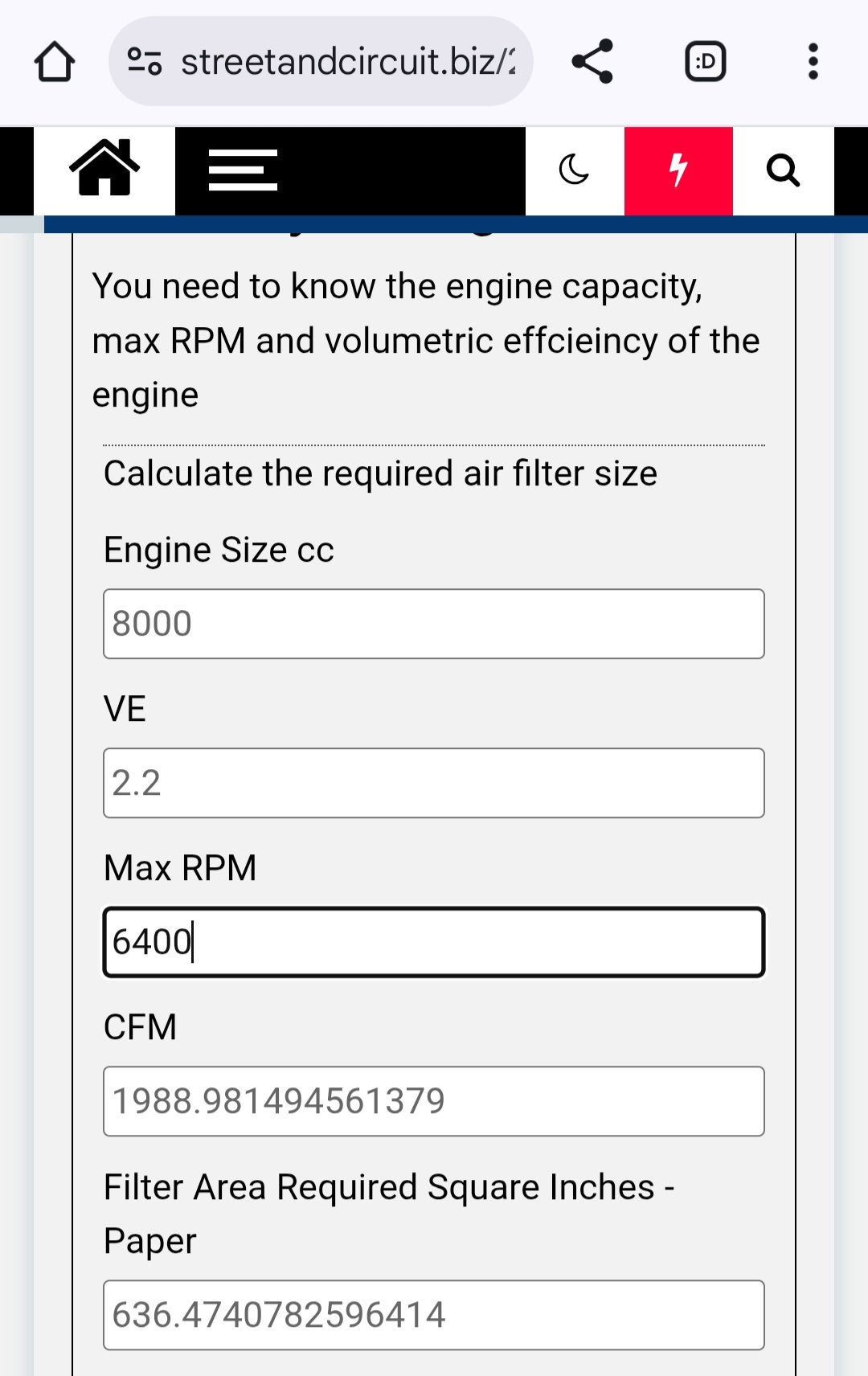
I also found another site with an online calculator which may have the same underlying formulas, and punched in some numbers there and at least the Naturally Aspirated CFM formula yielded a matching required CFM value (904 CFM).

I need to create an Excel for this (but I repeat myself...).

OK, without further ado, the calculations:
(EDIT: Added another streetandcircuit.biz calculation using the 2.2 VE value derived earlier.
Note: if using that website, don't click the Submit button - not necessary to see the results and actually takes you to another webpage without the results!)
Image
Image
Image
Image
Image
Image
Last edited by hernanca on Tue Jul 15, 2025 10:10 am, edited 2 times in total.
By worf
#313268
hernanca wrote: Wed Jul 09, 2025 1:41 am Short Answer:
2 928 filters are not enough for that Veyron based on the K&N formulas.
I couldn't easily find your bottom line on how too-small is the Veyron's filter capacity.

But, the polarity is what I expected of K&N's math.

I guess those Bugatti engineers just don't know what they're doing. Or...

... there's things K&N ain't tellin' us. Or some things we don't know. Yet.
By hernanca
#313270
I will clean up the above later. Late night, sore foot, etc.

The unknown variables I see at play here are:

A. Packaging. (Edit: i.e., packaging limitations)
B. Just how much pressure drop is considered acceptable/negligible from limited filter size?
C. What are the actual VE values, boosted or otherwise?
D. What are the actual CFM values of the different filter configurations and how are those determined? Is it tied to some acceptable pressure drop, like how an injector rating assumes a given fuel pressure?
E. Pleats vs flat. Pleats of course have more surface area, but the implication seems that the cfm ratings come from the structure + material, and to compare apples to apples in the context of packaging, just the face surface area is used in comparisons, thus "per square inch" means "of the face of the filter" and not "of the actual surface area when it is all stretched/flattened out".

Item B may be the biggest player, and the most hyped/abused, though I still believe every little bit helps. Recall that Kibort took measurements of a tightly sealed intake set up and found pressure drop - need to dig up his numbers.

When I throw this into Excel, it will allow us to play more with the numbers.

(Edit: Looking into item D, I found this excellent filter comparison:
https://www.billswebspace.com/AirFilterTest.htm
From the verbiage used there and elsewhere, it seems that filters have a linear correlation [Edit: direct correlation (but probably not "linear")] between resistance and CFM flowing through them. So "correct filter size" seems quite relative. All we can really say right now is: a bigger filter of the same brand will flow better than a smaller filter of the same brand. If we can better quantify the flows, then we can compare across brands. However, as also pointed out in the article, a better flow is likely from a compromise with better filtration.)
Last edited by hernanca on Tue Jul 15, 2025 2:46 pm, edited 3 times in total.
By Sazerac
#313571
hernanca wrote: Wed Jul 09, 2025 10:39 am E. Pleats vs flat. Pleats of course have more surface area, but the implication seems that the cfm ratings come from the structure + material, and to compare apples to apples in the context of packaging, just the face surface area is used in comparisons, thus "per square inch" means "of the face of the filter" and not "of the actual surface area when it is all stretched/flattened out".

I have some vague experience in sizing filters for some applications. Indeed, the pleats play a big role. There will be somewhere a pressure drop curve across the filter as a function of (1) the total surface area (i.e. flattened) and (2) how much dirt the filter has in it. A system designer will want to know that the filter is works in the system both at beginning and end of life. Beginning of life will be without dirt and end of life will be at the maximum expected amount of dirt in the filter. Further, the specification will have to define the distribution of the size of the dirt particles in the assumed dirt. In the applications I have been involved with, we have used as a baseline "Arizona Coarse Dust."

As a reference example there is some info here: https://www.ksl-staubtechnik.de/produkte/arizona-staub/
Or check the ISO Standard ISO 12103-1.
By hernanca
#313764
worf wrote: Tue Jul 08, 2025 11:18 am The 8 liter, ~18 PSI quad-turbo, 1200 hp, 6400 RPM Bugatti Veyron uses two 928 air filters.

What does the K&N formula say for that motor?
The forced induction complicates things, but it also highlights how many assumptions are being made, which may have been the point of the assigned exercise? :biggrin:
maddog2020 wrote: Tue Jul 08, 2025 10:39 pm 6.5 liters at 7800 RPM's should be interesting. cylinder head air flow should come into the picture somehow as well.
It should indeed! From what I am starting to understand, the way cylinder head airflow may come into play is in whether the filter resistance (impedance) is preventing it from reaching its potential at the higher RPM. If I am also understanding "the square law" correctly, increasing flow exponentially increases resistance (impedance). For example, doubling air flow can quadruple resistance (impedance). What I still don't know is how much of a hill of beans does it matter? We are talking about a large, metal air pump creating a vacuum which draws the air through the resistant filter.
Sazerac wrote: Sat Jul 12, 2025 8:49 am
hernanca wrote: Wed Jul 09, 2025 10:39 am E. Pleats vs flat. Pleats of course have more surface area, but the implication seems that the cfm ratings come from the structure + material, and to compare apples to apples in the context of packaging, just the face surface area is used in comparisons, thus "per square inch" means "of the face of the filter" and not "of the actual surface area when it is all stretched/flattened out".

I have some vague experience in sizing filters for some applications. Indeed, the pleats play a big role. There will be somewhere a pressure drop curve across the filter as a function of (1) the total surface area (i.e. flattened) and (2) how much dirt the filter has in it. A system designer will want to know that the filter is works in the system both at beginning and end of life. Beginning of life will be without dirt and end of life will be at the maximum expected amount of dirt in the filter. Further, the specification will have to define the distribution of the size of the dirt particles in the assumed dirt. In the applications I have been involved with, we have used as a baseline "Arizona Coarse Dust."

As a reference example there is some info here: https://www.ksl-staubtechnik.de/produkte/arizona-staub/
Or check the ISO Standard ISO 12103-1.
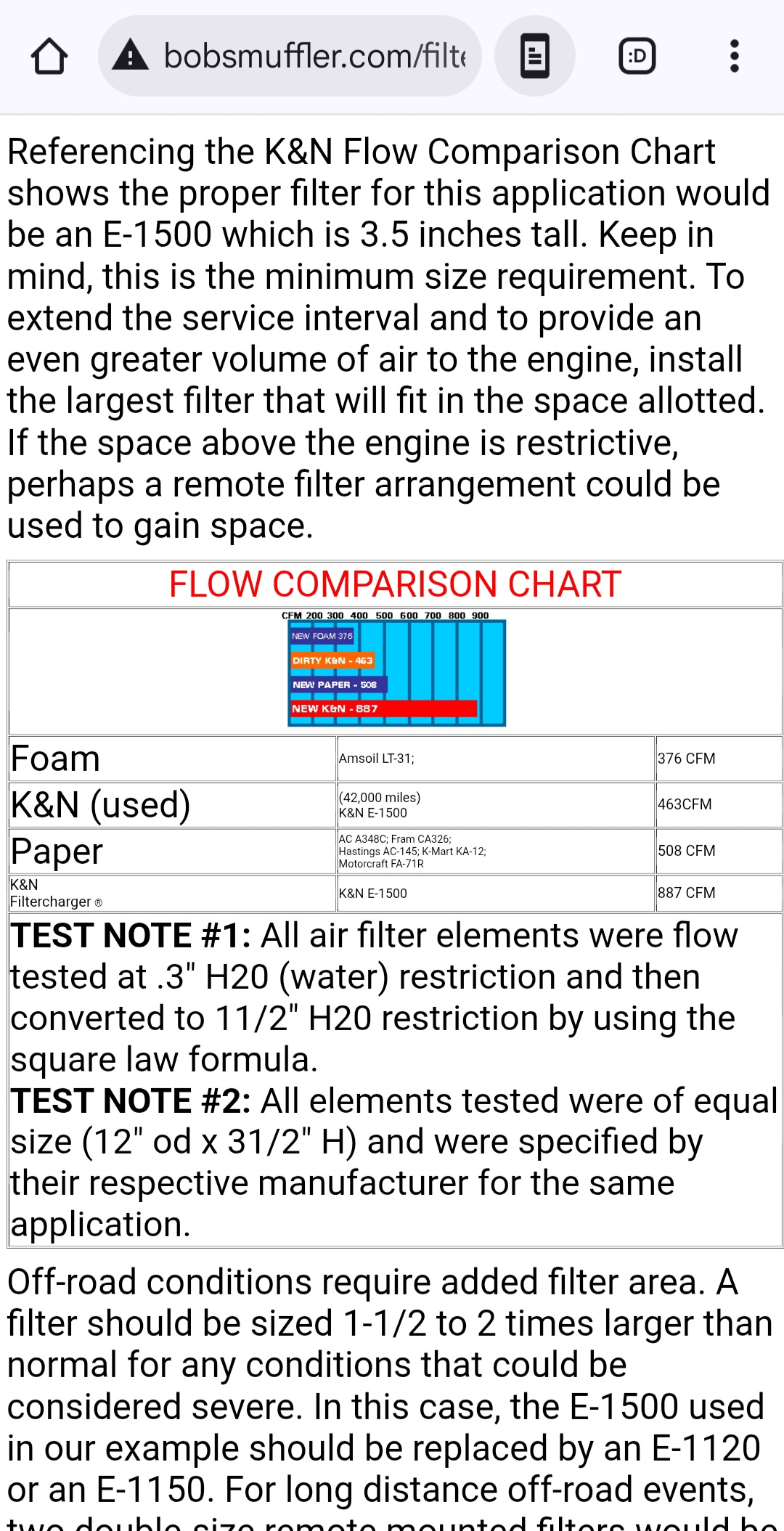
Thank you @Sazerac! That agrees with what I have read. It seems to me that any filter can handle a wide range of CFM. However, there will be different pressure drops (resistance, impedance) at different CFM (and depending on how much dirt it contains). The values given (e.g., 6.03 CFM Per Square inch for K&N), have an associated resistance, but I haven't figured out exactly what it is yet. The Bob's Mufflers site talks about comparing filters and measuring flow at a particular pressure, then applying "the square law" -- not sure why?

I have not put formulas into a spreadsheet yet, and have not cleaned up the calculation sheets yet, but I am trying to understand how all the different variables interact. An interesting exercise, I think, would be to accept the assumptions provided and figure out what size paper filter would give the same CFM at the same resistance value as a K&N filter of a specied size?

For my 6.5L motor, I am going to increase the filter area as much as possible, within my packaging constraints. 1.3x would be in line with my displacement increase (1.3x5.0 = 6.5), but if I can increase it by more, I will!
XR4Tim liked this
By worf
#313809
hernanca wrote: Mon Jul 14, 2025 11:52 pm ... then applying "the square law" -- not sure why?
At some point you have to apply compressible fluid flow math instead of incompressible fluid flow math.

I suspect that this "square law" thing is an approximation for compressible flow. But, I didn't review the math above.

And, I haven't finished my first cup of coffee yet, and am thus breaking my rule of no posts before coffee cup #2. That rule exists to keep me from posting dumb shit.
By N_Jay
#313816
Interesting thread.

Inducing nightmares of the single fluid dynamics class us EEs had to take. :hiding:
By hernanca
#313817
@N_Jay :evilgrin:

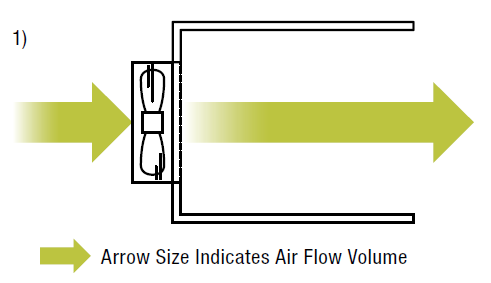
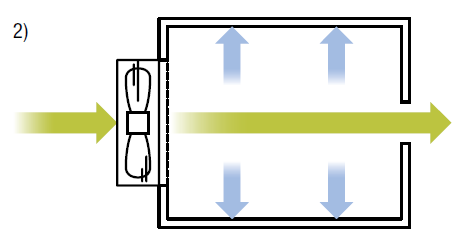
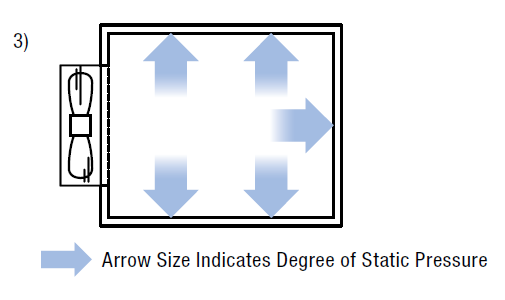
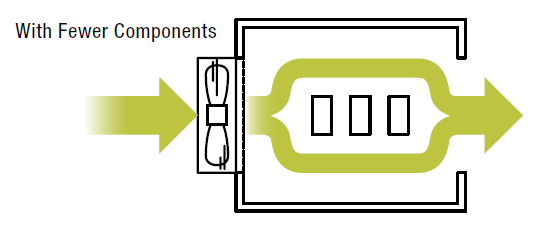
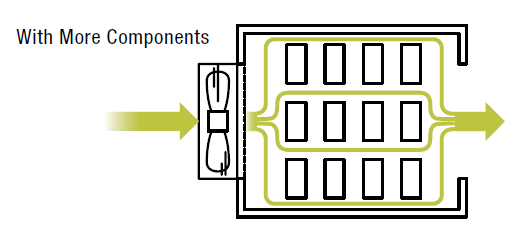
What I found in the InterWebz related to "the square law" and airflow had to do with the relationship between airflow and "static pressure" (impedance). The specific example had to do with cooling fans in computers and 3 different static pressure scenarios.

Image
Image
Image
Image
Image

There may indeed be a "square law" having to do with compressible flow (blissfully ignorant of such), but the way "the square law" was referenced in the Bob's Muffler filter comparison web page referenced below - see TEST NOTE #1, I believe it was more about the pressure introduced by the filter? Don't know if those are one and the same!? Or even if what I found is applicable!
Image
By worf
#313823
They told me there'd be no math before Noon.

hernanca wrote: Tue Jul 15, 2025 10:27 am What I found in the InterWebz related to "the square law" and airflow had to do with the relationship between airflow and "static pressure" (impedance). The specific example had to do with cooling fans in computers and 3 different static pressure scenarios.
Looking at those pictures I'm going to bet that this squared law is indeed an approximation for low-to-mid Mach compressible fluid flow math in a specific context. And I suspect that the term "impedance" is also a context-specific term of art to abstract away and combine density changes and friction.

This is a fun exercise and I hear the squeaking of long-closed mental doors' hinges. (There's also the PTSD from 1.5 years of fluid flow courses with exams containing questions like "Determine the maximum speed of a swallow...")

Let's do keep in mind that Bugatti's engineers decided that a single 928 filter was perfectly adequate for 600 hp.

If you look at it from that simple standpoint: sucking enough air to make a measured 600 hp through an air filter, a lot of the complexity can be dispensed with until you get closer to 600 hp with a 928 engine.

So... let's have fun with this, but it doesn't need to be a showstopper or something to lose sleep about.

And remember: A K&N filter on a stock 928 5.0 makes NO extra power as compared to the stock Mann/Mahle filter.
hernanca, Hey_Allen liked this
By Hey_Allen
#313885
Call me a cynic, but I wouldn't put it past K&N to have skewed the data that they posted, since they are in the business of selling filters based on the assumption that factory filters are restricting your engine.
hernanca liked this
By Rick Carter
#313894
worf wrote: Tue Jul 15, 2025 11:18 am They told me there'd be no math before Noon.

hernanca wrote: Tue Jul 15, 2025 10:27 am What I found in the InterWebz related to "the square law" and airflow had to do with the relationship between airflow and "static pressure" (impedance). The specific example had to do with cooling fans in computers and 3 different static pressure scenarios.
Looking at those pictures I'm going to bet that this squared law is indeed an approximation for low-to-mid Mach compressible fluid flow math in a specific context. And I suspect that the term "impedance" is also a context-specific term of art to abstract away and combine density changes and friction.

This is a fun exercise and I hear the squeaking of long-closed mental doors' hinges. (There's also the PTSD from 1.5 years of fluid flow courses with exams containing questions like "Determine the maximum speed of a swallow...")

Let's do keep in mind that Bugatti's engineers decided that a single 928 filter was perfectly adequate for 600 hp.

If you look at it from that simple standpoint: sucking enough air to make a measured 600 hp through an air filter, a lot of the complexity can be dispensed with until you get closer to 600 hp with a 928 engine.

So... let's have fun with this, but it doesn't need to be a showstopper or something to lose sleep about.

And remember: A K&N filter on a stock 928 5.0 makes NO extra power as compared to the stock Mann/Mahle filter.
Verified this for myself (K&N v stock) on a dyno
hernanca liked this
By hernanca
#313962
worf wrote: Tue Jul 15, 2025 11:18 am
This is a fun exercise and I hear the squeaking of long-closed mental doors' hinges. (There's also the PTSD from 1.5 years of fluid flow courses with exams containing questions like "Determine the maximum speed of a swallow...")
Agree! Though the PTSD in my case was a singular "Diffy-Q" class, and Physics 1 & 2 repeats.
worf wrote: Tue Jul 15, 2025 11:18 am Let's do keep in mind that Bugatti's engineers decided that a single 928 filter was perfectly adequate for 600 hp.

If you look at it from that simple standpoint: sucking enough air to make a measured 600 hp through an air filter, a lot of the complexity can be dispensed with until you get closer to 600 hp with a 928 engine.

So... let's have fun with this, but it doesn't need to be a showstopper or something to lose sleep about.
That is very reassuring, since my current goal is below 600hp for the stroker.

Not to mention that according to a recent health class, sleep is quite UNDER-rated!
Hey_Allen wrote: Wed Jul 16, 2025 2:04 am Call me a cynic, but I wouldn't put it past K&N to have skewed the data that they posted, since they are in the business of selling filters based on the assumption that factory filters are restricting your engine.
Rick Carter wrote: Wed Jul 16, 2025 8:28 am
worf wrote: Tue Jul 15, 2025 11:18 am
And remember: A K&N filter on a stock 928 5.0 makes NO extra power as compared to the stock Mann/Mahle filter.
Verified this for myself (K&N v stock) on a dyno
Gentlemen, are we saying that the obviously well-fed and always smiling guard which has been diligently reporting to us on the health of the chickens under his care has a rather fox-like resemblance?!! Say it ain't so!!!! :frown:

Your observations make me think that the numbers are skewed as follows:
1) The importance of the different CFM#@resistance# ratings are exaggerated, and
2) The calculated filter sizing is based on the "better flowing" K&N CFM ratings at some yet-to-be-figured-out resistance value. The formula itself contains their CFM rating. Something very fox-like about that.... But what a lucky coincidence that the K&N formula (for THEIR filters) was pretty spot on for the 4.5 and 4.7 928 motors! That made the fox's report quite believable to me.

I believe enough independent tests have shown that the K&N filters are "better flowing" (greater CFM per square inch for a given resistance #), but the tests I have read show the trade off is the filtering ability. The dyno is demonstrating that the flow difference is not significant when comparing to the stock filter on a stock motor. On the flip side, could the filtering difference also not be significant? Ah, well, time to sleep on this!
New S4 engine project

just to finish off this thread, early 2022 i asked[…]

Autocrossing

Had a fun Saturday. It started last week with […]

This is where we are.

I stopped taking my 928 into the shop in the late […]

Bring A Trailer finds

I have zero need for an electric golf cart, but if[…]